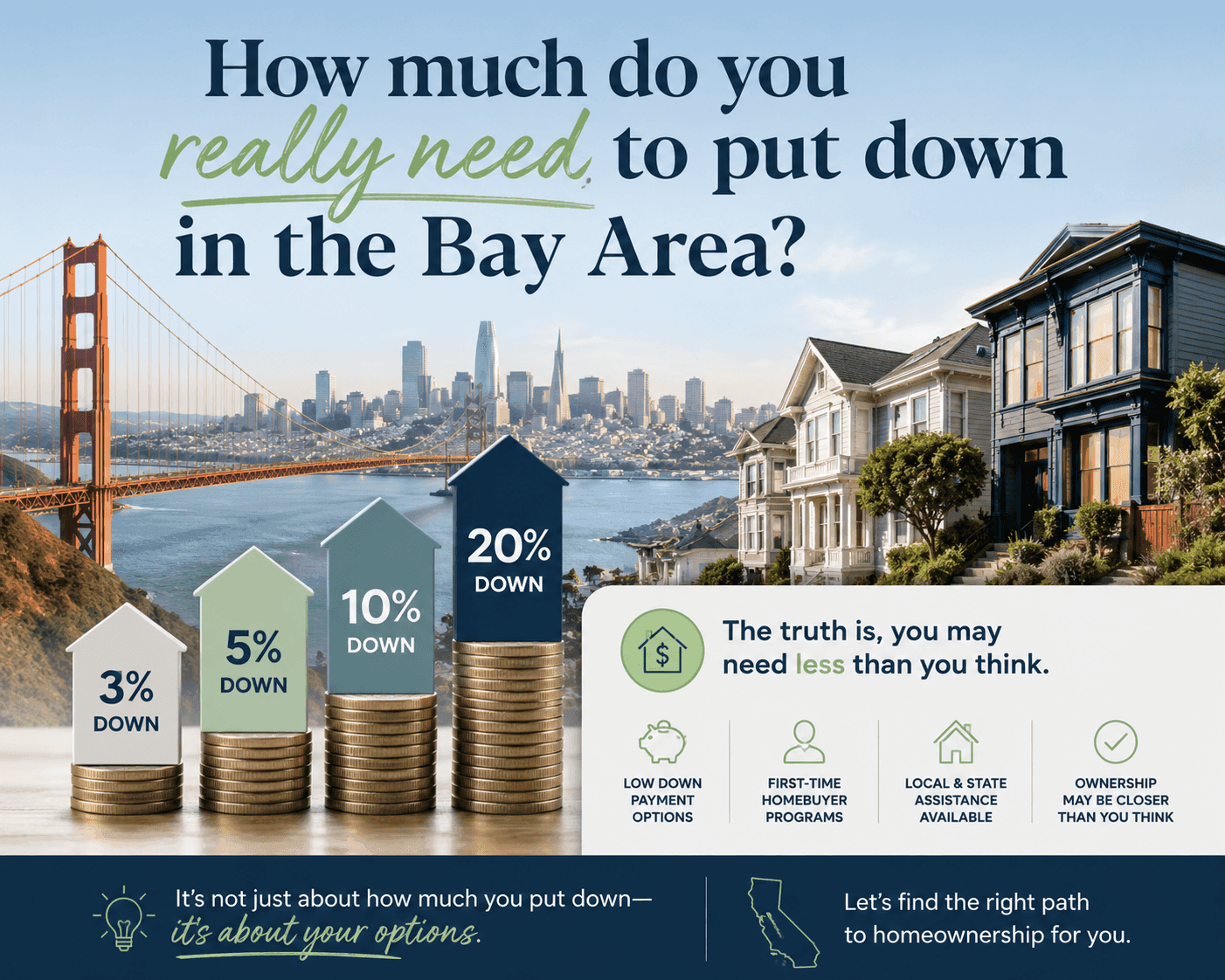
If you’ve been putting off buying a home in the Bay Area because you’re not sure you have enough saved — you’re not alone. The down payment question stops more buyers in their tracks than almost any other part of the process.
And honestly, it’s easy to see why. When you’re looking at homes priced at $1.5M, $1.6M, or more, the math can feel overwhelming before you even start. But here’s what most buyers don’t realize: the amount you actually need to put down is almost always less than they think. And in Santa Clara County, there are programs that can help even more.
This guide breaks down exactly how down payments work in the Bay Area — by loan type, by price range, and by what actually makes sense for your situation in 2026.
There is no single required down payment for buying a home. The amount depends entirely on your loan type, your loan amount, and your financial profile. Here’s the honest breakdown for Santa Clara County buyers in 2026:
| Loan Type | Minimum Down | Key Detail |
|---|---|---|
| FHA Loan | 3.5% | Max loan $1,249,125 in Santa Clara County · 580+ credit score |
| Conventional | 3% | Best for conforming loan range up to ~$832,750 |
| VA Loan | 0% | Eligible veterans — no down payment required |
| Jumbo Loan | 10–20% | Most Bay Area purchases — some programs start at 5% |
| Down Payment Assistance | Up to $150,000+ | Multiple programs available in Santa Clara County |
On a $1.6M home: 10% down = $160,000 · 20% down = $320,000
On a $1.2M home: 3.5% FHA down = $42,000 · 10% down = $120,000
With a median home price of $1.6M in Santa Clara County, most buyers are purchasing in the high-balance or jumbo range — which means the conventional “3% down” advice you see online often doesn’t apply directly to this market. Here’s how the numbers actually play out by tier:
Available on purchases up to roughly $858,000 (putting 3% down on the $832,750 conforming limit). Useful for condos, townhomes, and entry-level properties in the South Bay. Even the condo median in Santa Clara County sits at $1,125,000, so this tier applies to a narrower slice of the market than buyers often expect.
Available up to the FHA limit of $1,249,125 in Santa Clara County. A 3.5% down payment on a $1.2M purchase is $42,000 — a meaningful but achievable target for many buyers. FHA requires mortgage insurance, which adds to your monthly payment but opens the door for buyers with lower down payments or credit scores in the 580–620 range.
Many jumbo lenders now offer programs starting at 10% down for well-qualified borrowers. On a $1.6M purchase, that’s $160,000 down — borrowing $1,440,000. Requires strong credit (typically 720+), solid reserves, and full income documentation. This is the path most commonly used by South Bay buyers today.
The traditional jumbo down payment. On a $1.6M home that’s $320,000 down. Puts you in the strongest qualifying position — best rates, most lender options, and no mortgage insurance. Not always the right move financially, but often the cleanest path from a loan qualification standpoint.
It depends on your cash position, your income, your reserves after closing, and your longer-term financial strategy. This is a conversation worth having with your lender before you decide on a target.
This is the part most Bay Area buyers don’t know about — and it’s genuinely worth understanding before you assume you can’t afford to buy here. Several assistance options may be available, but funding windows and eligibility rules change quickly. For example, some local programs may be fully subscribed or limited to buyers who already have pre-approval. This is why it’s important to review current program availability before building your purchase plan.
CalHFA Dream For All
Up to $150,000
Shared appreciation loan · No monthly payments · Income limits up to ~$316K for Bay Area households · Lottery-based when open
CalHFA MyHome
Up to 3.5%
Deferred-payment junior loan · No monthly payments · Repaid at sale or refinance · Available statewide with no funding cap
Empower Homebuyers SCC
Up to 17%
Santa Clara County program · Zero interest · No monthly payments · Combine with 3% buyer contribution to reach 20% down
SJ First-Time Buyer
Up to $120,000
City of San Jose program · Income-qualified first-time buyers · Must purchase within San Jose city limits
Multiple programs can be combined for even greater assistance — for example, pairing CalHFA MyHome with the Empower Homebuyers SCC program. Most require completion of a HUD-certified homebuyer education course (an 8-hour class available online). Start the education requirement early — it’s a one-time step and opens the door to significant assistance.
This is the most persistent myth in the market. Buyers regularly purchase homes in Santa Clara County with 10%, and sometimes less, depending on loan type and profile. The right target depends on your specific situation — not a generic rule.
Not in 2026. CalHFA’s income limits in the Bay Area reach up to $316,000 in household income for some programs. Many tech employees, teachers, nurses, and working professionals qualify — and most don’t realize it. It’s worth checking before you assume you don’t qualify.
Not necessarily. Putting more cash into a down payment means less liquid cash in your reserves — and reserves matter significantly for both loan qualification and financial security after closing. The right down payment balances your qualification, your monthly payment, and your financial cushion. This decision is worth a real conversation before you commit.
The opposite is almost always true. Talking to a lender early — even 6 to 12 months before you plan to buy — gives you a specific, accurate savings target based on your actual situation. Knowing your real number is far more useful than estimating from a general rule of thumb.
Gift funds from immediate family members are allowed on most loan types, including conventional and FHA. There are documentation requirements, but it’s a fully accepted and very common practice. Your lender can walk you through exactly what’s needed.
Your down payment is only one piece of the equation. Closing costs in California typically run 2–3% of the purchase price — on a $1.6M home, that’s another $32,000 to $48,000. After both of those costs, how much liquid cash will you have? Most jumbo lenders want to see 6–12 months of mortgage payments in accessible reserves after closing. Plan for all three numbers, not just the down payment.
On conventional loans, putting down less than 20% triggers private mortgage insurance (PMI). On FHA loans, mortgage insurance is required regardless of down payment. On jumbo loans, there is no PMI regardless of your down payment — which changes the true cost comparison between different scenarios significantly.
Tying up $320,000 in a down payment has a real cost — that cash isn’t available for reserves, investments, or future flexibility. Some buyers are better served by a 10% jumbo down payment and keeping more liquidity. Others sleep better with 20% down and a lower payment. Neither is wrong — they reflect different priorities, and the right answer depends on your situation.
On a $1.6M purchase, the difference in monthly payment between 10% down and 20% down is meaningful — but so is keeping $160,000 more in accessible cash. Running those two scenarios side by side takes 10 minutes and can clarify the decision significantly. That’s a conversation I have with buyers every week.
Whether you have $200,000 saved or $50,000, there are real options worth understanding — and the right path looks different for every buyer. Let’s look at your actual situation together.
(408) 687-6109 — Call or Text ChrisWhether you have $200,000 saved or $50,000, there are real options worth understanding — and the right path forward looks different for every buyer. The goal of any conversation with me isn’t to push you into a purchase before you’re ready. It’s to give you an honest picture of where you stand, what your real targets are, and which programs might be available to help.
That kind of clarity makes the whole process less stressful — and it costs you nothing to have the conversation.
How much do I need for a down payment on a home in San Jose or Santa Clara County in 2026?
It depends on your loan type. FHA loans require as little as 3.5% down up to $1,249,125. Jumbo loans typically start at 10% down. On a $1.6M home, 10% is $160,000 and 20% is $320,000. Down payment assistance programs can reduce your out-of-pocket requirement significantly.
Do I really need 20% down to buy in the Bay Area?
No. While 20% is the traditional target for jumbo loans, many programs allow 10% or less for well-qualified borrowers. The right amount depends on your loan type, credit profile, and overall financial picture.
What down payment assistance programs are available in Santa Clara County in 2026?
Several programs are available including CalHFA Dream For All (up to $150,000), CalHFA MyHome (up to 3.5% of purchase price), the Empower Homebuyers SCC program (up to 17% of purchase price with no interest), and the San Jose First-Time Homebuyer Program (up to $120,000). Income limits are more generous than most buyers expect — up to approximately $316,000 for some Bay Area programs.
Can I use gift funds for a down payment in California?
Yes. Gift funds from immediate family members are accepted on most loan types including conventional and FHA, with proper documentation. Your lender can walk you through the specific requirements.
When should I start talking to a lender about my down payment?
As early as possible — ideally 6 to 12 months before you plan to buy. An early conversation gives you a specific, accurate savings target rather than a general estimate, and helps you understand which programs you may qualify for before funding windows close.
